

A bunion is more than a bump on the side of your foot — it is a structural shift in the bones of the big toe joint that tends to worsen over time. When shoe changes, padding and other conservative measures stop helping, surgery becomes an option. But there is no single “bunion operation.” Instead, surgeons choose from several distinct techniques, each suited to a different severity, foot structure and lifestyle. Understanding the main types of bunion surgery helps you have a more informed conversation with your surgeon and set realistic expectations for recovery. This guide breaks down the osteotomy, Lapidus, Lapiplasty and minimally invasive options — who each suits, how recovery compares, and what they typically cost.
What Bunion Surgery Actually Corrects
A bunion, known medically as hallux valgus, develops when the first metatarsal bone drifts toward the inside of the foot while the big toe angles toward its neighbours. The result is the familiar bony prominence at the base of the big toe — but the visible bump is only part of the problem. Beneath it, the joint, tendons and ligaments have shifted out of alignment. According to the American Academy of Orthopaedic Surgeons, surgery aims to relieve pain and realign the joint, not simply shave away the bump. Because deformities range from mild to severe — and because some involve an unstable joint at the base of the metatarsal — one technique cannot fit every foot. The right procedure depends on how far the bones have moved, whether the joint is hypermobile or arthritic, your age and how active you are. That is why bunion correction surgery comes in several distinct forms.
The Main Types of Bunion Surgery
Surgeons group bunion procedures into a handful of families, and most operations combine more than one technique. Your surgeon may also adjust the plan once they review your weight-bearing X-rays. If you are weighing your options, our guide to bunion surgery in Turkey explains how each of these procedures is delivered for international patients. Most patients fall into the osteotomy or fusion categories, and which one suits you depends far more on the severity and stability of your deformity than on personal preference.
Osteotomy
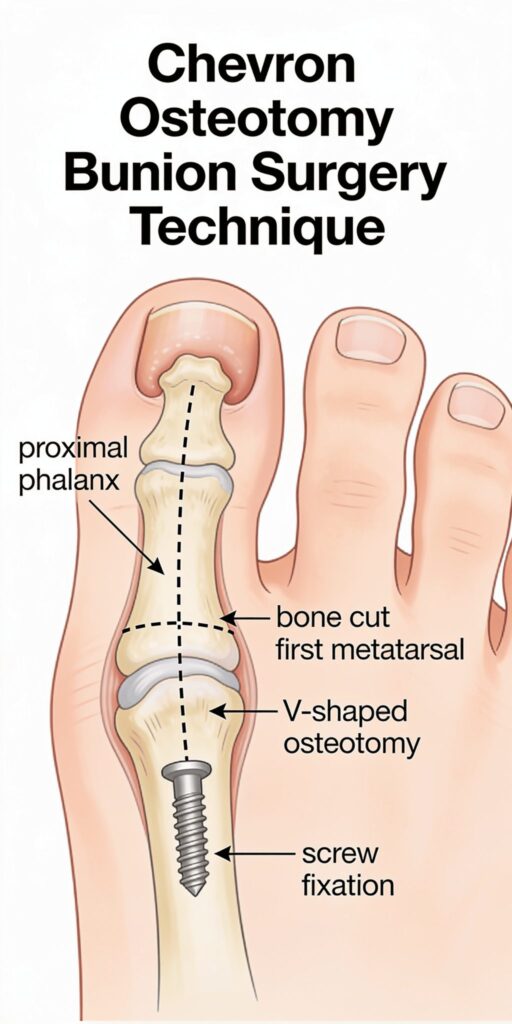
An osteotomy is the most common type of bunion surgery. The surgeon makes a precise cut in the first metatarsal, shifts the bone back into alignment and fixes it with small screws, pins or a plate. Several variations exist: a chevron osteotomy uses a V-shaped cut near the head of the bone and suits mild to moderate bunions, while a scarf osteotomy uses a longer Z-shaped cut for moderate deformities. A proximal osteotomy, made nearer the base of the bone, corrects larger angles, and an Akin osteotomy — which reshapes the toe bone itself — is often added to fine-tune alignment.
Exostectomy (Simple Bunionectomy)
An exostectomy, sometimes called a simple bunionectomy, removes only the bony bump without realigning the metatarsal. It is reserved for mild cases where the prominence is the main complaint, and it is rarely performed on its own: without correcting the underlying misalignment, the bunion frequently returns. For that reason it is usually combined with an osteotomy rather than used as a standalone fix.
Lapidus Procedure
The Lapidus procedure, or first tarsometatarsal fusion, targets the joint at the base of the metatarsal rather than the bump itself. The surgeon fuses this joint to lock the bone into a corrected position, which is especially useful when the joint is hypermobile or the deformity is moderate to severe. Because it addresses the root cause of instability, the Lapidus offers durable correction with a low rate of recurrence. The trade-off is a more involved operation and, traditionally, a longer period before full weight-bearing.
Lapiplasty (3D Bunion Correction)
Lapiplasty is a branded, instrumented version of the Lapidus procedure that corrects the bunion in three dimensions — side to side, up and down, and rotationally — before fixing the joint with a titanium plate. The hardware is designed to be stable enough that many patients can bear weight in a boot within days rather than weeks, while still benefiting from the low recurrence rate associated with fusion-based correction.
Minimally Invasive Bunion Surgery (MIS)
Minimally invasive bunion surgery corrects the deformity through several incisions just a few millimetres wide. Using specialised burrs and real-time X-ray guidance, the surgeon reshapes and repositions the bone, then secures it with screws placed through the skin. The appeal is smaller scars, less soft-tissue trauma and, for many patients, a quicker early recovery. Modern fixated MIS techniques have narrowed the historical gap in recurrence rates, though candidacy still depends on the size of the deformity.
Arthrodesis and Arthroplasty
For severe bunions complicated by arthritis, or for revision after a failed surgery, the big toe joint itself may need to be addressed. Arthrodesis fuses the metatarsophalangeal joint for a permanent, highly stable result, at the cost of joint movement. Resection arthroplasty, which removes part of the joint, is occasionally used for older, less active patients. These are specialist options a surgeon reserves for specific cases.

Which Procedure Suits Which Bunion?
No two feet are identical, and the “best” operation is the one matched to your deformity and goals rather than the newest name. As a general guide, simpler techniques handle milder deformities while fusion-based procedures handle instability and severe cases. The table below summarises how the main types of bunion surgery compare on severity, invasiveness, recovery and the likelihood of the bunion returning. Use it as a starting point for the conversation with your surgeon — not as a substitute for an examination and weight-bearing X-rays.
| Procedure | Best for | Invasiveness | Weight-bearing / recovery | Recurrence risk |
|---|---|---|---|---|
| Osteotomy (chevron / scarf) | Mild to moderate | Moderate, small–medium incision | Protected weight-bearing in a stiff shoe, often early | Low–moderate |
| Simple bunionectomy | Mild (bump only) | Low | Quick, but usually combined with another technique | High if used alone |
| Lapidus procedure | Moderate to severe, hypermobility | Higher, larger incision | Traditionally delayed; modern fixation can be earlier | Low |
| Lapiplasty (3D) | Moderate to severe, hypermobility | Higher, plate fixation | Often weight-bearing in a boot within days | Low |
| Minimally invasive (MIS) | Mild to moderate (some severe) | Lowest, millimetre incisions | Smaller scars, often quicker early recovery | Low–moderate (modern fixated) |
| MTP joint fusion (arthrodesis) | Severe with arthritis | Higher | Protected weight-bearing; joint motion is lost | Very low |
Recovery and recurrence figures are general ranges; your surgeon’s technique and your individual healing will shape the actual timeline.
Recovery: What to Expect After Bunion Surgery
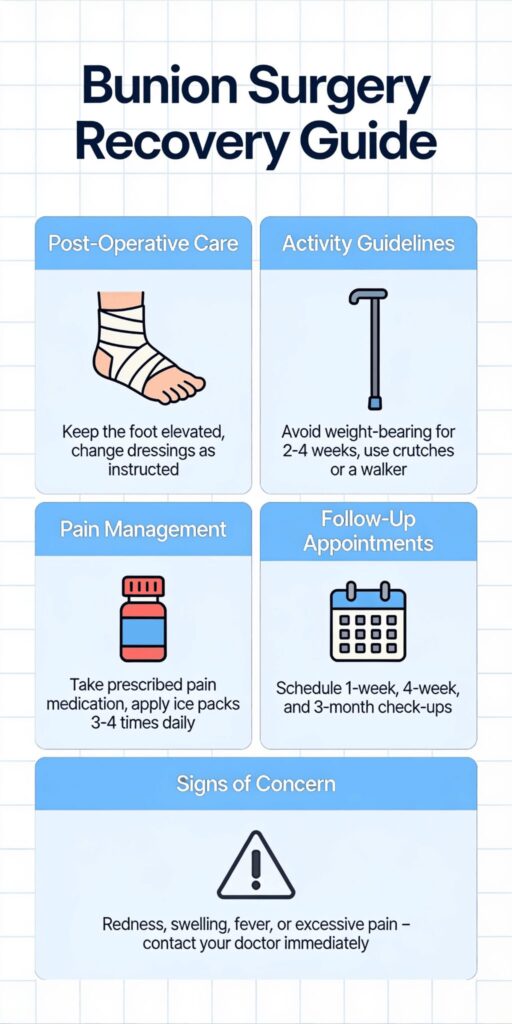
Most bunion procedures are performed as day surgery, so you will usually go home the same day. Beyond that, the timeline depends heavily on which technique you had. Procedures that cut and pin the bone, such as osteotomies and many MIS operations, often allow protected weight-bearing in a stiff-soled surgical shoe within the first week or two. Fusion-based procedures historically required a longer non-weight-bearing phase, although modern plate fixation — including Lapiplasty — has shortened this for many patients.
Across all types, expect stitches to come out around two weeks, with the foot needing continued support from dressings, a boot or a brace for roughly six to twelve weeks. Swelling is normal and can linger for months; returning to regular shoes and higher-impact activity commonly takes three to six months. Following your surgeon’s instructions on dressing care and weight-bearing is essential, because disturbing the position of the bones can compromise the correction.
For a detailed, week-by-week breakdown of healing, swelling and getting back on your feet, see our full guide to bunion surgery recovery.
How Surgeons Choose the Right Procedure
Before recommending a technique, your surgeon will examine the foot and order weight-bearing X-rays, which reveal the true angles of the deformity when the foot is loaded. They will look at how far the metatarsal has drifted, how much the toe has rotated, whether the joint at the base of the metatarsal is unstable and whether arthritis is present. Your age, bone quality, activity level and how quickly you need to return to work all factor in too. A young, active patient with a hypermobile joint may be steered toward a fusion-based correction for durability, while an older patient with a mild deformity might be a candidate for a less invasive approach. The aim is always to match the procedure to your foot — which is why the same diagnosis can lead to different recommendations for different people.
Cost and Having Bunion Surgery Abroad
Cost is one of the biggest questions patients have, yet it is rarely addressed clearly. In practice, the price of bunion surgery varies widely depending on the procedure, the type of anaesthesia, surgeon and facility fees, and whether hardware such as plates is used. Fusion-based and instrumented techniques like Lapiplasty generally sit at the higher end, while simpler osteotomies cost less. Insurance often covers the procedure when it is judged medically necessary rather than cosmetic, though deductibles, co-pays and facility fees can still leave a sizeable bill. In countries without universal coverage, out-of-pocket totals can run into many thousands of dollars, which is one reason a growing number of patients explore treatment abroad.
Destinations such as Istanbul have become popular for orthopedic procedures, often pairing experienced foot-and-ankle surgeons and accredited hospitals with significantly lower prices. If you are considering surgery overseas, weigh more than the headline cost: check the surgeon’s credentials and case volume, the hospital’s accreditation, and — crucially — how follow-up and any complications will be managed once you return home.
Frequently Asked Questions
What is the most common type of bunion surgery?
The osteotomy is the most common type of bunion surgery. It involves cutting and realigning the first metatarsal and fixing it in place, and it suits the mild-to-moderate deformities that make up the majority of cases.
What is the newest type of bunion surgery?
Minimally invasive (percutaneous) techniques and Lapiplasty are among the newest approaches. Both aim to reduce recovery time — MIS through very small incisions, and Lapiplasty through stable three-plane fixation that allows earlier weight-bearing.
Which bunion surgery has the fastest recovery?
Minimally invasive surgery and Lapiplasty tend to offer the quickest early recovery, as many patients can bear weight in a protective shoe or boot within days. Full recovery, however, still takes several months regardless of the technique used.
How long does bunion surgery take?
The operation itself usually takes between roughly 45 minutes and a couple of hours, depending on the procedure and whether more than one technique is combined. It is typically performed as outpatient day surgery, so an overnight hospital stay is uncommon.
Is minimally invasive bunion surgery better than traditional surgery?
Not necessarily — it is better for the right patient. MIS offers smaller scars and less soft-tissue trauma, but traditional open and fusion procedures may give more reliable correction for severe or unstable bunions. The best choice depends on your specific deformity.
Can bunions come back after surgery?
Yes, bunions can recur, particularly after procedures that remove the bump without correcting the underlying misalignment. Fusion-based techniques such as the Lapidus and Lapiplasty have the lowest recurrence rates because they stabilise the root cause of the deformity.
Choosing the Right Bunion Surgery for You
There is no universally “best” bunion operation — only the procedure best suited to your foot, your deformity and your life. Osteotomies remain the workhorse for mild-to-moderate bunions, fusion-based techniques like the Lapidus and Lapiplasty deliver durable correction for unstable or severe cases, and minimally invasive surgery offers a lower-impact route for suitable candidates. The most important step is a thorough assessment with an experienced foot-and-ankle surgeon who can match the technique to your needs.
Considering treatment abroad? See how each procedure is delivered for international patients and what to expect from start to finish.